Overview
This is a 2-month team project done as a submission for CHI 2019 Student Design Competition. With the given prompt "Weaving the thread within the social fabric", we narrowed our focus to connected neighbors and neighborhood. We designed an app that builds trust and fosters relationships in the neighborhood through a safe and secure venue in the digital age.
My Role
Literature review, User interview, Focus groups, co-design workshop, Prototyping, Usability Testing, Interaction Design, UI Design, and Video Production
Teammates
Elizabeth King, Sydney Arnold, Jessie Zhu
NeighborCircle
Problem Space
We believe that neighborhood is the building block of social fabrics. It is through the true connection of neighbors that communities can thrive, individuals can be known, and the fabric that connects us gets stronger.
However, research result has shown that 1 in 3 Americans never interact with their neighbors, as compared to 1 in 5 Americans in the 1950’s, and 2 and 3 millennials don’t feel like they belong to their local community. American neighborhood has become less cohesive as a community.
Source: City Observatory https://www.thecut.com/2015/08/third-of-americans-dont-know-their-neighbors.html
We would like to investigate what makes a connected neighborhood and how might design encourage more social interaction among neighbors in the digital age.
Secondary Research- Existing Products
To start with, our team did initial research focused on understanding what current methodologies and forms exist to connect neighbors.
Nextdoor:
A popular app serves to connect neighbors through information sharing to those directly in their neighborhood
Limitation: Most people use it as an informational app. It lacks a way for neighbors to truly connect based on interests and similarities and build friendships. Although users are required to verify their address, there is still concern from users about the level of privacy and security for users sharing their information.
NeighborFavor:
An app that connects neighbors through services and “offering a helping hand"
Limitation: The monetary incentive makes it more like a service rather than helping out and bonding with a neighbor
Tea with Strangers:
A platform that encourages people to get to know "strangers" in a small-gathering setting ( limit 5 people)
Limitation: It can be challenging for more introverted individuals and has a large barrier to entry.
Overall Insight:
Services like these thrive upon a level of trust and comfort between neighbors and strangers that may not yet exist. Without trust and certainty, services like these are likely to go unused.
Primary Research
We focused on the Bloomington, IN, which represents a typical type of American neighborhood in small towns, to provide a case study for neighborhood communities. Our overall research goal is to understand what does "connecting with neighbors" mean for different people, and how might we foster a connected community. In total, our team conducted 5 one-on-one interviews, a focus group discussion, and a co-design workshop.
Interviews
GOAL: To understand the dynamic of being and having a neighbor while also learning about struggles, successes, and interactions.
INSIGHTS:
-
Face-to-face interaction is the driving force behind a connected neighborhood and a positive neighbor experience. By talking in person, there is a large opportunity for neighbors to grow as friends.
-
face-to-face interaction is a challenge for new or introverted neighbors and can be a strong barrier to entry.
Focus Group
GOALS: To see and experience the dynamic between neighbors in a social setting, and find out how face-to-face interactions are facilitated in a close-knit neighborhood
INSIGHTS:
-
face-to-face interactions often established a sense of security and personal interaction between neighbors, allowing them to form more connected relationships in the future.
-
Although HOA’s are established in neighborhoods, it overall did not provide connections between the neighbors.
"...I don’t really know how to get to know the neighbors. I don’t like to knock on people’s door, interrupting whatever they have going on in their day...People make assumptions about why strangers are knocking on their door. Selling or needing something?... " - Ashely, employee at IU
"We have spring fling, 4th of July parade, fall picnic etc. and we fee more connected because of this type of things… I have a personal tradition of inviting people over my porch and hang out together… I prefer something easy and straightforward. Face-to-face interactions and phone calls are the best…" - Georg'ann, retired
Focus group session
Co-design Workshop
GOALS:To understand a diverse set of needs, pains, and opportunities from each neighborhood and explore design ideas directly with our target audience
Activity 1: Needs Statement
We started with asking the participants to create needs statement (I need a way to_____ so that_____) in order to see the biggest needs that neighbors currently had.
Core Needs: Get to know neighbors; Stay in touch with each other; Deal with problems together; Connect with like-minded people; Emergency help from neighbors
Activity 2: Brainstorming & Idea Remix
We then asked the participants to begin brainstorming possible solutions based on need statements. As they worked, our team probed the participants on what they were creating using What-if Cards.
Afterward, we asked the participants to work together to “remix” their ideas – to combine various aspects from each concept to create a single solution that addressed a particular need or pain point.
Insights: Participants pursued a design that incorporates both digital and physical aspects
We created 5 what-if cards as design probes
Activity 3: Design Critique:Thinking hats
After combining ideas, we critiqued the design and worked through different perspectives by putting on different “hats”, including Idea Generator hat, Pessimistic hat, Optimistic hat, and User Advocate hat. The critique probed some great discussions, and we were able to see the opportunities and limitations of the final design and how it connected back to the initial need statements created.
" I just want to know the info of who live in my neighbors, just in case, I don’t necessarily want to walk around and talk to people. When opportunities come, maybe. But it’s more having that just in case. I’m sure other people may want more events, more ways to participate in things. " - Dana, employee at IU


INSIGHT SUMMARY
To summarize, our primary research yielded the following major insights:
-
Face-to-face interactions were crucial to connected relationships and those connections also provide a sense of security and personal interaction that help build upon that relationship.
-
"Connecting with neighbors" has different meanings for different people. Some may enjoy small talks and social gathering, some may just want to know who lives in the neighborhood just in case.
-
HOAs are an established form within neighborhoods but are often are not a center point for the neighborhood and do not provide a lot of connectivity for neighbors.
-
There were three crucial aspects the solution needed to incorporate for success: allowing individuals to opt-in rather than restrict or force them to participate, must be open and easily accessible to the public, and must incorporate both a digital and non-digital aspect to the design.
Ideation
Taken the insights from our research, we ideated around several design concepts, including favor for neighbors, connect with neighbors with similar interests, get to know your neighbors, and a bulletin board that keeps neighbors updated (The design that came up by participants in the workshop)
Concept 1: Favor for Neighbors
A platform that encourages neighbors to help each out. They can earn "leaves" by providing help. As more favor offered, the digital community mascot grows to signify the achievement and build a sense of belonging to the community.
Why we didn't choose this
There're existed products like Nextdoor, IU classified that serve similar functions. For smaller neighborhoods, some needs may be hard to fulfill.
Concept 2: Interest Mailbox
Neighbors decorate their mailboxes with "interest pins" so that neighbors can connect with like-minded neighbors. They can also send event invites base on interest via an app.
Why we didn't choose this
Some mailboxes in the neighborhood may not be publicly accessible. The concept places the focus on gamification and may fail to address the fundamental needs of people. It also has a bigger barrier to entry.
Concept 3: Know Your Neighbors Kiosk
A kiosk that's publicly accessible in the community. Pressing on "neighbor" on the kiosk randomly prints out a postcard of a neighbor's profile and pressing on "event" prints out a list of upcoming events in the neighborhood. Neighbors can send their info to the kiosk via an app.
Why we like about this
It corporates both physical and digital aspects and its' fun to interact with. It focuses on establishing the initial contact point for neighbors and has endless possibilities.
Critique and Iteration
Following a design critique from a design professor as well as our target user, we realized that the kiosk concept had a foundational issue: people are highly concerned about where their information is going and who has access to it. Our initial design concept focused heavily on how we can connect neighbors and make them known within a community, however it failed to address crucial privacy and trust concerns.
How we might create trust between neighbors as well as an information platform that allows neighbors to feel comfortable with face-to-face interactions?
DESIGN GOAL
Facilitate face-to-face interaction in the community by establishing an initial contact point for neighbors, and motivate them to stay in touch thereafter through a trusted and secure venue
The Design
Our concept is a mobile application that builds communities within neighborhoods by establishing security and trust prior to interactions so that lasting relationships can be built. The application connects through a neighborhood’s HOA. Although requiring a neighborhood to have an HOA for this concept is a limitation, we felt it was necessary in order to establish safety and security.
Onboarding
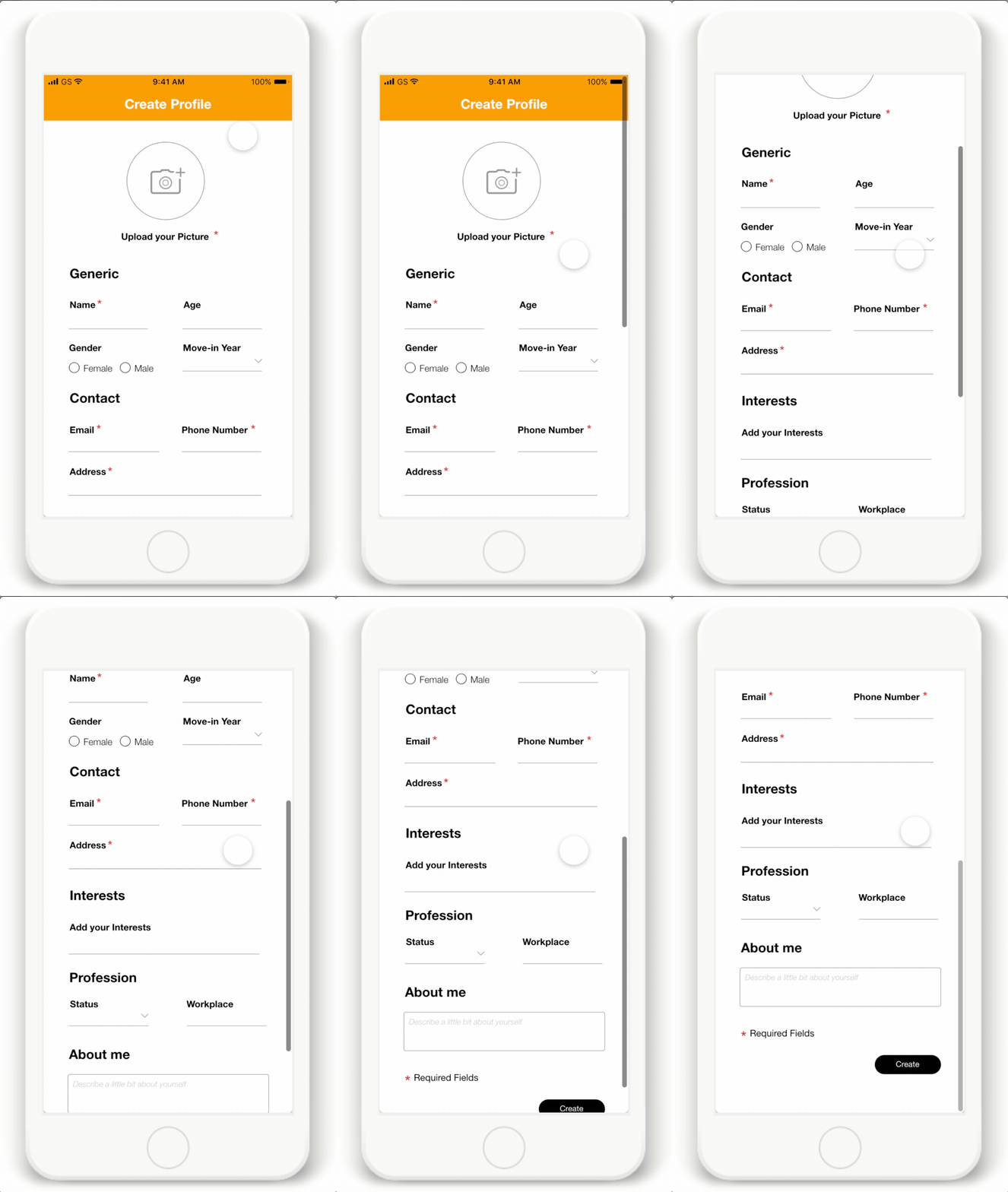
Before signup, each user needs to be verified and approved by HOA. After approval, the user is asked to create a profile with information relevant to housing and personal interest.
Map View
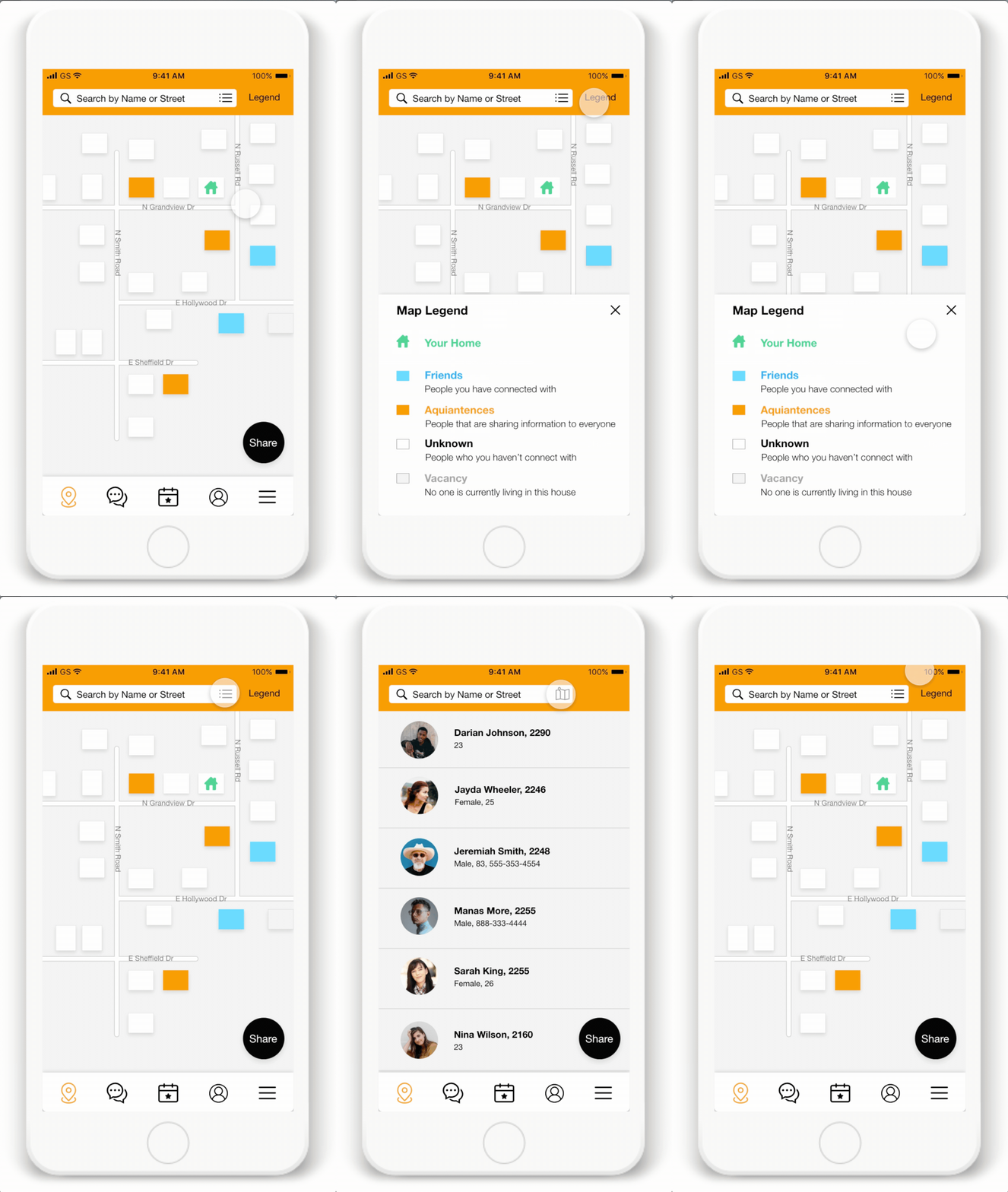
On the homepage, the user is able to see a map view of their neighbors' information with different color codes. Blue means that neighbor has shared their information with the user; Orange means that neighbors share their information publicly; White means the user hasn't built any connection with that neighbor.
List view and search features are provided for faster access to information.
We use map view as the default because from our research, people recognize/ memorize neighbors by where they live.
Share information
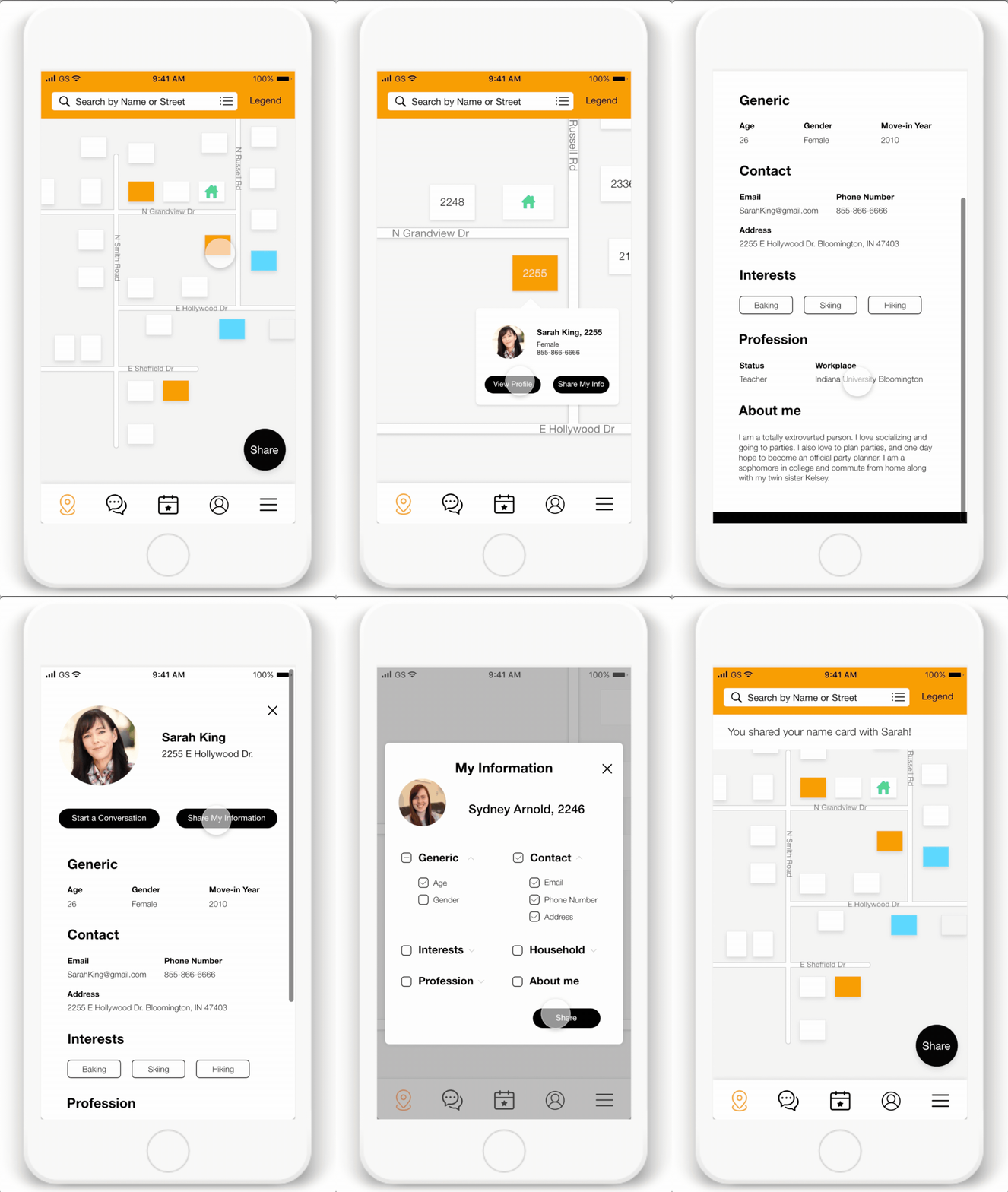
Clicking on the houses reveals information of that neighbor, if applicable.
Users can choose what information they would like to share with that neighbor depends on their comfort level. They can update their sharing setting once they get more comfortable with that neighbor.
Attend and host events
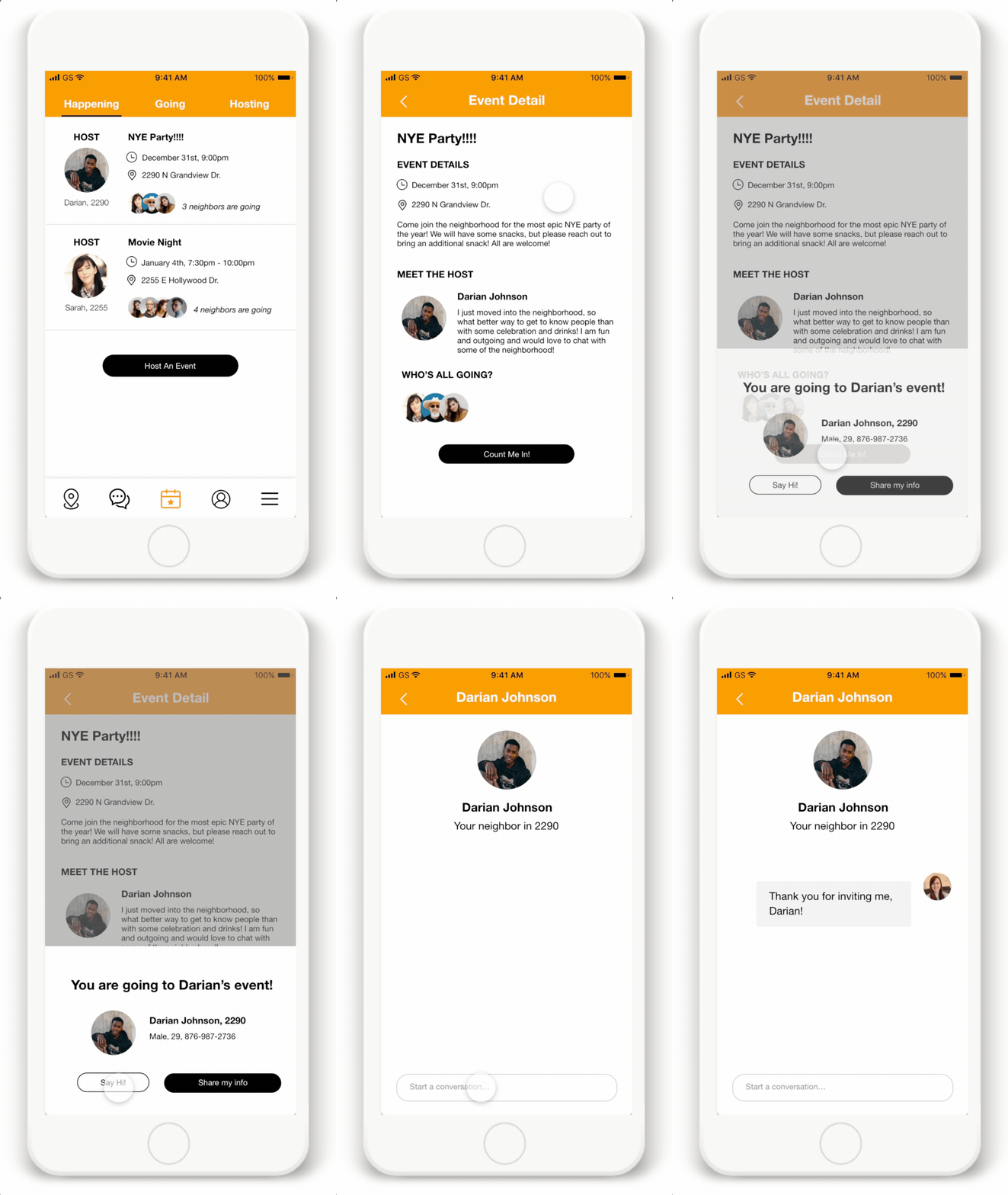
Events section allows each user to view events that are going on along with details of the event. In addition, it also shows other neighbors who are attending in hopes of promoting more neighborhood connectivity.
Upon confirm "going" to an event, NeighborCircle prompts the user to say hi and share name card with the event host.
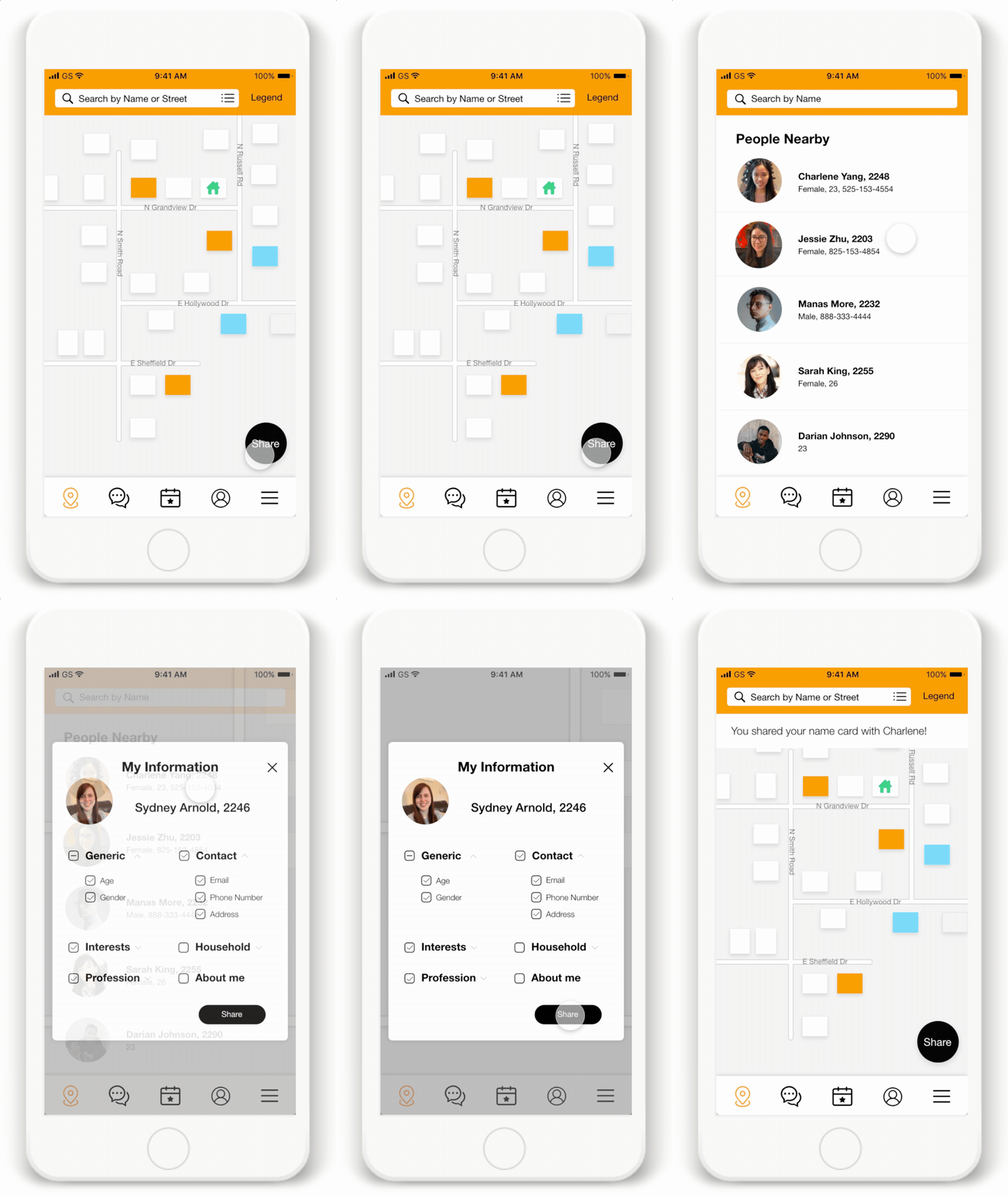
Exchange info with neighbors met face-to-face / in events
The share with people nearby feature of the app is ideal for neighbors to exchange information face-to-face.
As the user build more connections in the community, more blue houses appear on the map!
Discussion
We believe that NeighborCircle will create a more connected, thriving community. We see our design helping neighbors not only to share information, but also host events, construct friendships, create memories, and build a community.
If I have more time, I would...
1) Do a better job at conveying the message to users what their information is for, and think about the proper timing in their flow to ask for the information.
2) Further explore the "event" feature of the app. Provides some inspiration for get-together ideas for the neighborhood and encourage more offline interaction.
3) Explore ways for neighbors to connect via common interest. People are more willing to fill out their interest and personal information when there is purpose --connect with more like-minded people.
Feedback from judges
"There’s a really strong design process behind the app, and I particularly liked the creative workshop methods (e.g. the needs statements). There are some good clear findings from this process and it’s clear how they have made their way into the final design."
" This is an interesting topic area grounded in real problem with loneliness that is widespread in our digital age. I particularly liked the offline element that the authors have tried to encourage. It is refreshing to see a submission that is truly user-centric, utilizing the technology as a way to mediate relationship formation as opposed to encouraging faceless online interactions. "